

T Levels
Get a head start towards the future you want with T Levels!
T level courses are two-year courses that are equivalent to 3 A Levels. Developed in collaboration with employers and education providers, T Levels combine academic classroom learning with meaningful industry placement, in order to prepare students for entry into skilled employment.
Since the introduction of T Levels in 2020, we have seen students go on to achieve great things within industries they care about - whether that be through higher education, apprenticeships, or employment.
What is a T Level Foundation Year?
T Level Foundation Years are designed to equip students with fundamental knowledge and practical skills, preparing them for their upcoming T Level and the exciting world of work. These courses focus on building students' English, maths, and digital skills within a context relevant to their chosen industry.
As part of our commitment to providing outstanding technical education, we're thrilled to offer a T Level Foundation Year pathway in Business, Accountancy & Digital Skills. This year-long course bridges the gap between GCSEs and a T Level for pupils who may not quite meet the entry requirements to start on a T level straight after GCSE completion.


What is the difference between technical qualifications, A Levels, and T Levels?
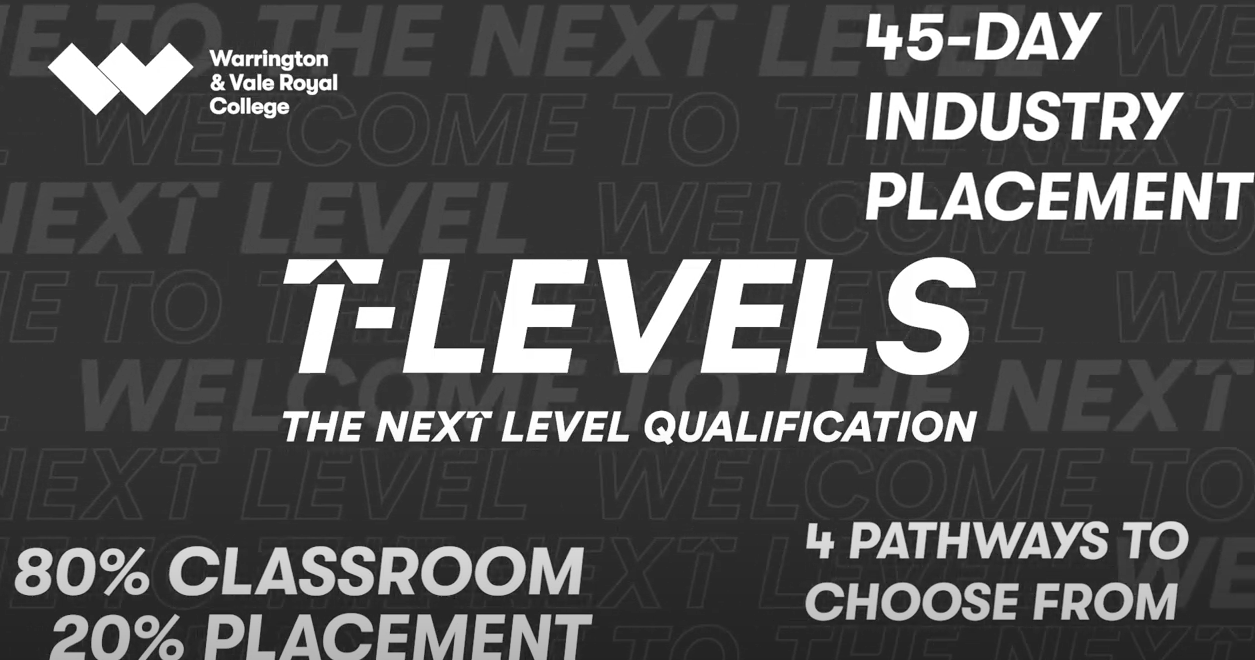
A Levels are assessed mainly through exams, while technical courses are assessed mainly by coursework. T Levels are assessed by a mixture of both exams and coursework and require the completion of a 45-day industry placement.
All 3 course types are valuable and provide UCAS points, with level 3 diploma vocational qualifications and T Levels being considered the equivalent to three A Levels.
Can I go to university after studying a T Level?
Yes! T Levels are nationally-recognised level 3 qualifications and are worth UCAS points. Therefore, these courses are highly valued by universities and other education providers.
How do T Levels differ from an apprenticeship?
Apprenticeships typically involve around 80% paid, on-the-job training and 20% classroom learning.
In contrast, T Levels are made up of approximately 80% classroom-based study and 20% industry placement.
With an apprenticeship, students find their own employer and are taken on as paid members of staff, with apprenticeships lasting between 1-4 years. T Levels, however, are completed over 2 years.

Mercy Asaolu
College course: T Level Health: Adult Nursing
Destination: Adult Nursing at the University of Chester
Mercy decided to study T Level Health due to her keen interest in health-related topics. She believed this pathway would give her the opportunity to explore her passion through a practical, hands-on approach that perfectly matches her preferred style of learning. Mercy has particularly enjoyed the aspects of the course beyond the classroom, whether that’s taking part in subject trips with her peers or fully engaging in the hands-on elements during her placement hours.
Recently, she was delighted to receive a conditional offer to study Adult Nursing at the University of Chester, reinforcing that her time studying at Warrington & Vale Royal College has prepared her exceptionally well for her next steps.
“I would definitely recommend this course to anyone considering a future in the health & social care sector. My tutors have really helped me understand the course and have allowed me to develop my skills – I now feel ready to take on my next steps at university.”
Jayden Fellows
Previous school: Beamont Collegiate Academy
College course: T Level Business, Management & Administration
As part of Jayden's T Level Business, Managaement & Administration course, he recently completed an industry placement with Jungheinrich UK. While working with Jungheinrich in their automations, service and sales departments, Jayden made a fantastic impression, with the Head of Learning & Development, calling him "a pleasure to work with." Jayden has loved the workplace experience that his T Level has given him, saying:
"My placement at Jungheinrich has been fantastic. It’s shown me the range of opportunities and potential careers a T Level in Business can lead to, thanks to the course's variety. My next step will be an apprenticeship, and I feel that everything I’ve learned at college has really prepared me for this!"